Electricity is the beginning, not the push
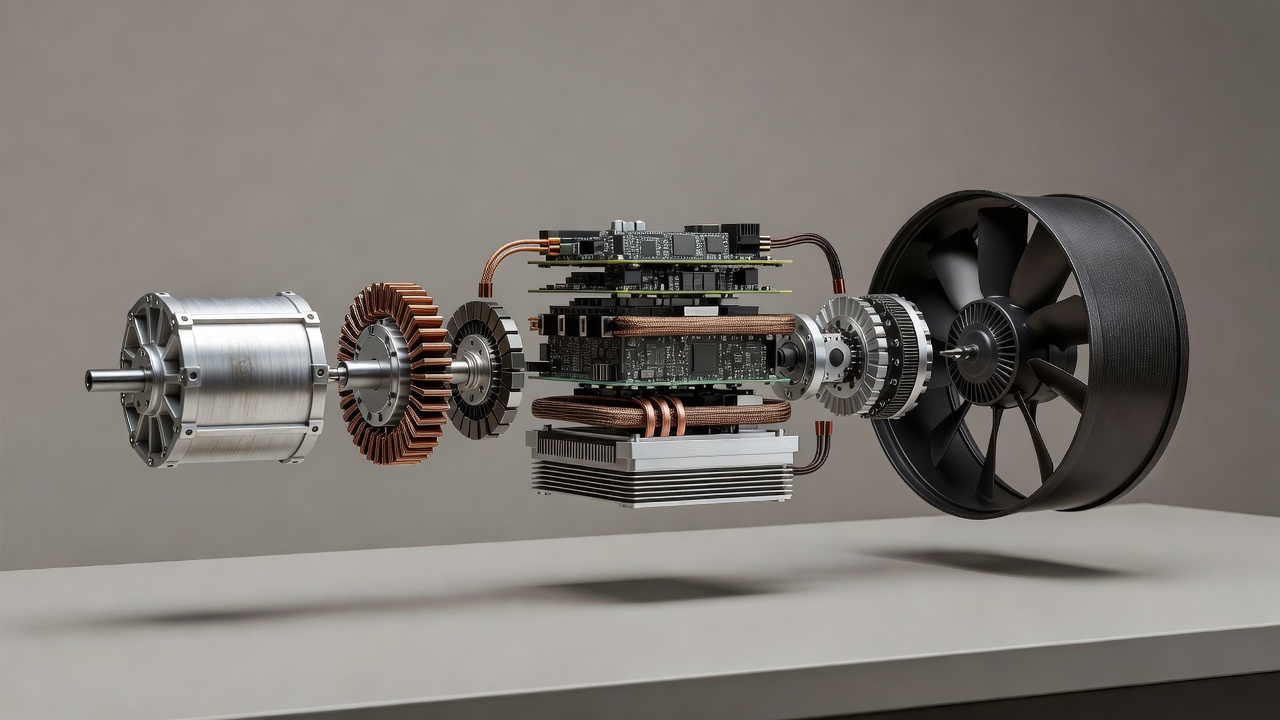
An electric vehicle converts stored electrical energy into mechanical work. In a common battery-electric drive, cells feed a power-electronics stage, an inverter controls the motor, and the motor turns a wheel or propulsor. Every stage imposes losses, mass and operating limits. The architecture matters more than the word “electric” printed on the bodywork.
A road vehicle pushes against the ground through tire contact. A propeller accelerates air, receiving an opposing force. Neither avoids momentum exchange. If a proposed machine appears to move without pushing on a road, air, exhaust or an external field, the missing interaction needs to be identified before its performance claims deserve attention.
What the wheel already does well
The humble electric bicycle is an unusually useful benchmark. Rolling support does not require the motor to hold the rider above the ground. At modest speeds, a compact drivetrain can assist human effort while leaving much of the vehicle mechanically familiar. Bosch eBike Systems and production machines such as the Nissan LEAF show different scales of the same broad energy-conversion chain, not identical engineering solutions.
A hub motor simplifies some mechanical connections but adds mass at the wheel. A mid-drive can use the bicycle’s gearing, yet introduces chain loads and shifting considerations. Neither arrangement is universally superior. Terrain, maintenance access, thermal limits and the intended duty cycle should shape the choice before a peak-power figure does.
When the reaction mass is air
Take away the supporting road and the comparison changes sharply. A hovering rotor must continuously move air to oppose weight. Ideal momentum theory indicates that, for a given lift, distributing that force over a larger rotor disk reduces induced power. Real machines add profile drag, motor losses, interference and control margins. A neat duct can help particular designs, but compactness is not a free efficiency improvement.
Forward flight offers another possibility: a wing can carry the weight while a propeller overcomes drag. That is why a small fixed-wing research aircraft cannot be treated as proof that the same propulsion technology can hover with a person aboard. Lift, launch method, speed and payload must accompany any demonstration video.
A quiet motor does not make a quiet aircraft. The air still has work to do.
The battery is part of the vehicle
Battery comparisons need a clear system boundary. Cell-level energy density excludes packaging, electrical connections, protection, thermal management and structural provisions. Usable pack energy can also be lower than nominal energy because operation must preserve safety margins and battery life. A pack that can deliver a brief burst may not tolerate that output continuously.
Heat is another form of evidence. Motor windings, switching devices and cells all warm during operation. Cooling hardware has weight and may require airflow that is unavailable during a low-speed climb or stationary test. Continuous ratings therefore tell a different story from attractive short-duration numbers. A credible prototype report states ambient conditions and explains how temperature was measured.
The stranger edge: ionic wind
MIT’s 2018 electroaerodynamic aircraft demonstrated flight using high-voltage electrodes to accelerate ions, which transferred momentum to surrounding air. It was an important physical demonstration without moving propulsion parts. It did not establish a practical passenger aircraft, and it did not remove the need for reaction mass: the atmosphere supplied that mass.
Scaling introduces questions about thrust density, high-voltage insulation, power-supply mass and environmental sensitivity. These are not reasons to dismiss the research. They are the work that separates an interesting mechanism from a useful transport system. Spacecraft ion thrusters belong to a different operating environment and should not be borrowed as evidence for atmospheric hover.
A useful reading of the next prototype
Ask for total vehicle mass, useful payload, measured electrical input and the exact maneuver demonstrated. Distinguish a tethered bench run from free flight, and a brief peak from repeatable operation. Then ask what happens when the battery is low or a cooling path becomes blocked. The answers are more revealing than a polished enclosure.
For broader context, the US Department of Energy’s Vehicle Technologies Office discusses electrified transport research. The MIT demonstration report is the primary starting point for the ionic-wind example. Our next question is structural: what must carry all this equipment?