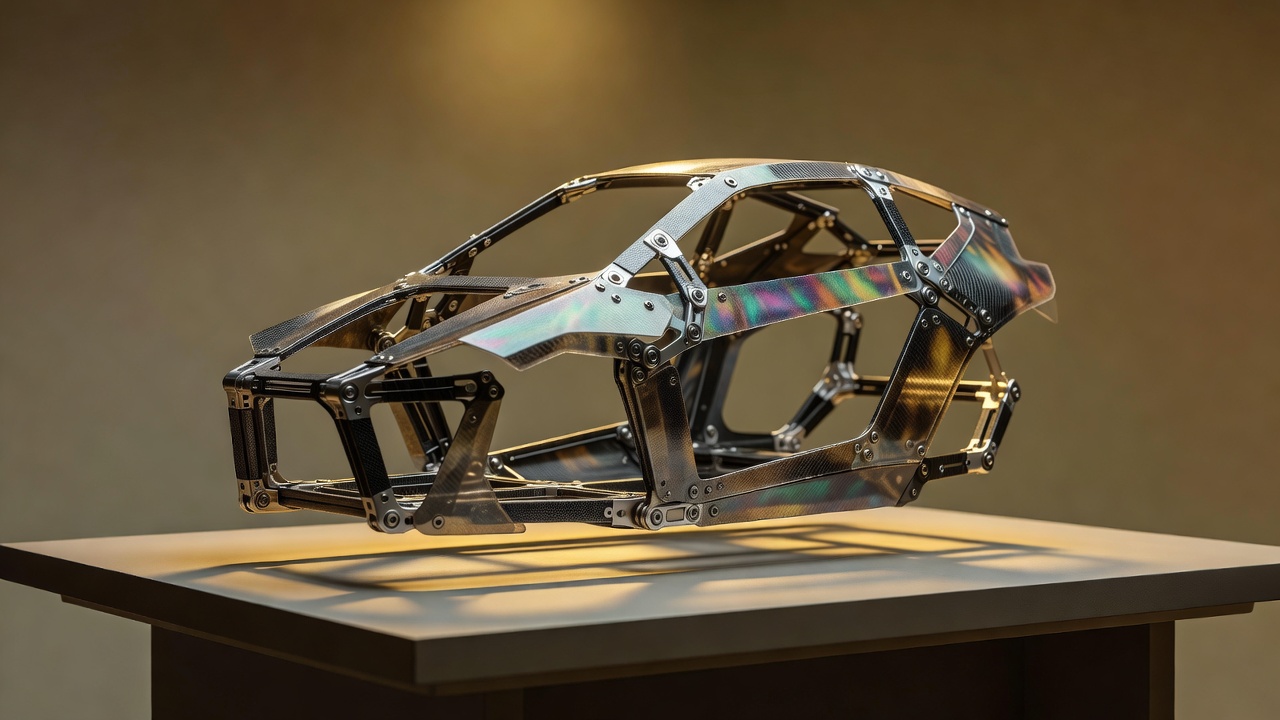
Start with the load path
Before selecting carbon fiber or a particular alloy, identify where forces enter and where they leave. A rider loads the seat, pedals and handlebars. Road inputs enter through the wheels. Braking creates longitudinal forces and bending moments. A propulsion unit adds torque, vibration and sometimes concentrated thrust. The structure must connect those interfaces without unacceptable deformation or failure.
Stiffness and strength answer different questions. A member may resist breaking yet flex enough to compromise steering or clearances. Another may feel rigid but fail abruptly when overloaded. Buckling introduces a further constraint: a thin compression member can lose stability before the material reaches its nominal strength. Geometry is therefore as important as the material label.
Material is only part of the bargain
Aluminum alloys can offer low density, established production methods and familiar inspection routes. Welding, heat treatment and local stress concentrations still influence performance. A beautifully machined part does not escape fatigue, and an alloy designation alone does not establish the properties of a finished assembly. Process history matters.
Steel remains useful where toughness, compact sections, cost and repair options outweigh a density penalty. Titanium can suit demanding corrosion or weight requirements, but material cost and fabrication difficulty complicate the case. The lightest raw material does not necessarily produce the lightest practical structure once wall thickness, connections and service requirements are included.
Carbon-fiber composites allow stiffness and strength to be directed through fiber orientation. That freedom also makes the design more dependent on layup, resin system, bonding and quality control. Impact damage may be difficult to see, and drilling or clamping can introduce local problems. Treating a composite tube like a thinner metal tube misses the behavior that makes it distinctive.
The joints are where promises meet hardware
A concept frame often looks continuous; an actual vehicle needs bearings, mounts, fasteners and accessible interfaces. A thin shell may require local reinforcement where a seat, suspension unit or battery enclosure attaches. Those reinforcements add mass, as do inserts, adhesives and protective layers. Weight estimates that omit them systematically favor unfinished designs.
Serviceability belongs in the same discussion. A replaceable bracket can weigh more than an integrated feature yet save an entire frame after a minor collision. A bonded enclosure may look efficient until a technician needs to inspect a hidden connection. Manufacturing consistency, inspection time and repair documentation can determine whether a lightweight design survives ordinary ownership.
The best kilogram to remove is one the machine never needed—not one its safety case quietly depends on.
The battery feedback loop has limits
Less structural mass can reduce energy demand, allowing a smaller battery, which can reduce mass again. The benefit depends on the mission. Climbing and repeated acceleration respond directly to weight, while steady high-speed travel may be dominated by aerodynamic drag. On level ground, reducing frontal area can sometimes matter more than removing a small amount of frame material.
For flying vehicles, weight has a more immediate effect on lift requirements and power. Yet aggressively reducing margins can undermine robustness, passenger protection or tolerance of manufacturing variation. A useful optimization considers the complete operating envelope rather than a single ideal flight or a carefully staged demonstration.
Testing is part of the object
A prototype should be evaluated for realistic loading, repeated cycles and foreseeable misuse. Fatigue testing asks how damage accumulates, not simply whether the frame can support a rider once. Environmental exposure, vibration and fastener loosening may change the answer over time. Simulation can guide decisions, but its assumptions must be checked against measurements and appropriate physical tests.
Standards provide structured questions rather than a universal stamp of safety. The ISO 4210 series addresses bicycle safety requirements and test methods within its scope. EN 15194 concerns electrically power-assisted cycles within its scope. Neither should be casually applied as proof that an unconventional aircraft, pod or novel vehicle is approved. Applicable editions, product categories and local rules need specialist review.
Read the mass figure carefully
Ask whether quoted mass includes the battery, cooling, protective enclosure, landing or support equipment and the parts required for legal operation. Separate empty mass, payload and operating mass. A render has no manufacturing tolerances; a real machine must accommodate them. The useful comparison is between complete vehicles capable of the same task.
For further reading, consult the standards catalogs at ISO and CEN and CENELEC, and the transportation research discussed by the German Aerospace Center, DLR. Then return to the energy chain: the frame and propulsion system are negotiating the same mission.