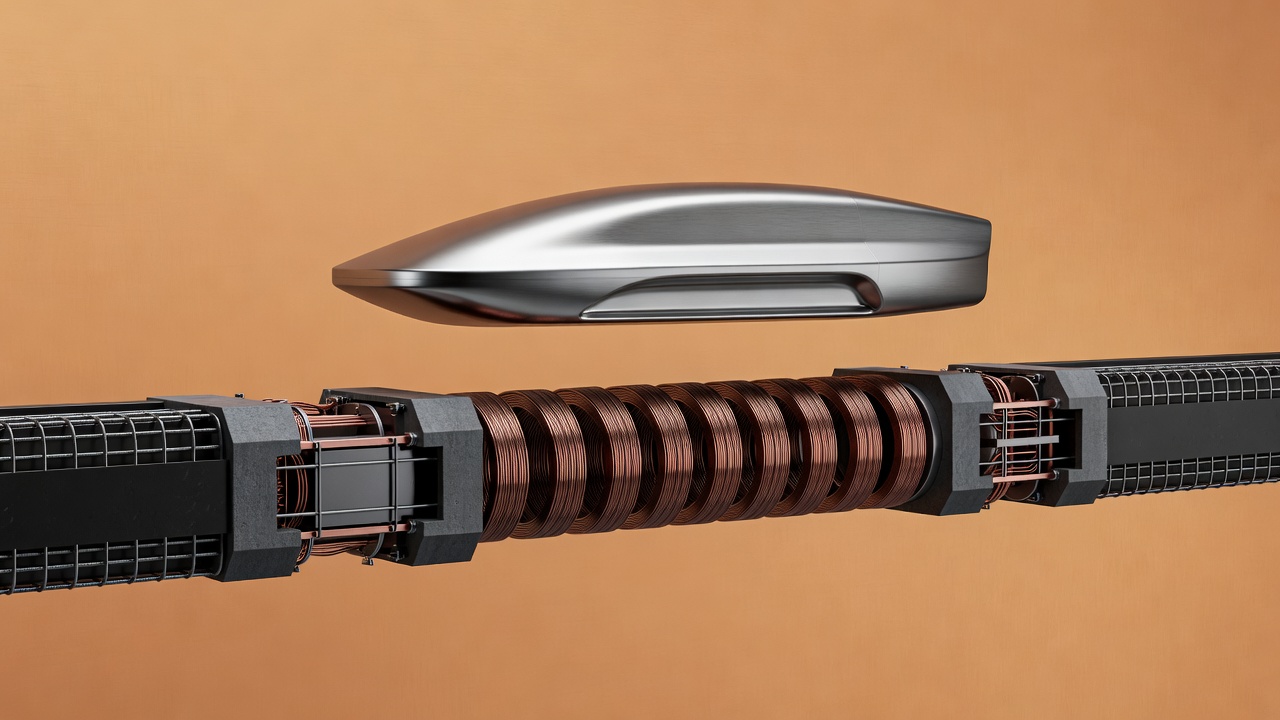
The load has not vanished
Levitation is a method of support, not the absence of support. The vehicle’s weight is transferred through electromagnetic interaction into a guideway and ultimately its foundations. Removing a wheel changes the interface, but it does not remove structural loads. The track must still resist forces, maintain alignment and accommodate environmental movement.
That distinction matters when a rail technology is presented as a personal hover device. An ordinary road is not a magnetic guideway. A machine that levitates over a carefully prepared demonstration surface has shown compatibility with that surface, not the ability to travel over any pavement. Infrastructure belongs inside the engineering comparison, even if it sits outside the camera frame.
Two families, different compromises
Electromagnetic suspension commonly uses controlled attraction between vehicle-mounted electromagnets and a ferromagnetic rail. Sensors and feedback maintain the operating gap. Attraction grows as the gap closes, so the control system has real stabilizing work to do. Clearance, track geometry, sensor reliability and emergency support become design questions rather than decorative details.
Electrodynamic suspension instead uses magnetic interaction that can include currents induced by relative motion. Some implementations require a minimum speed before adequate lift is available and use wheels at lower speeds. Superconducting systems can create strong magnetic fields, but their cryogenic equipment and associated operating requirements must be counted. These architectures should not be collapsed into a single claim that magnets “use no energy.”
Levitation and propulsion are separate jobs
A suspended vehicle can remain stationary. To move it along the route, a system still needs propulsion. Linear motors can develop force along the guideway rather than delivering torque through a rotating axle. Depending on the architecture, active equipment may be distributed between the vehicle and track. That distribution affects capital cost, vehicle mass, maintenance access and power delivery.
Contact-free support can reduce some sources of mechanical wear, yet aerodynamic drag remains. At high speeds, moving air can dominate the energy budget. Auxiliary loads, magnetic losses and cooling must also be included. Comparing only wheel friction with levitation power misses most of the system, particularly when vehicles differ in speed, capacity and route.
The absence of contact is an achievement. It is not the absence of a system.
What the railway examples establish
Central Japan Railway Company’s SCMAGLEV program demonstrates the seriousness of superconducting maglev as a railway technology. The Shanghai Maglev illustrates another high-speed application, while Japan’s Linimo shows that magnetic transport is not confined to the same speed class. They are distinct systems with different service conditions, not interchangeable evidence for a pocket-sized vehicle.
These examples move the conversation beyond whether levitation is real. The useful questions concern where it improves a transport service and what that improvement costs. A dedicated corridor with predictable loads is a different environment from a neighborhood street full of junctions, bicycles, delivery vehicles and pedestrians. Route geometry and passenger throughput can determine whether the infrastructure is justified.
Why scaling down does not solve everything
A personal pod may reduce individual vehicle mass, but it can multiply dispatching and spacing requirements. Switches, evacuation access, station capacity and recovery of a disabled vehicle still need solutions. Small cabins do not automatically produce a small network bill. A comparison should include how many people the corridor carries, not only how futuristic each vehicle appears.
Safety also extends beyond maintaining the magnetic gap. Engineers consider power interruption, degraded sensors, structural movement, fire response and safe stopping. Magnetic fields require assessment for passengers, workers and nearby equipment. The exact protections depend on the design; a generic illustration cannot establish exposure levels or certification readiness.
A better question for the floating prototype
Ask what creates lift, how stability is maintained, how motion is produced and what happens at rest. Then examine the track: construction tolerances, weather exposure, debris management and maintenance access. Request measured losses and an explicit system boundary before comparing energy performance with bicycles, rail or road vehicles.
Begin with JR Central’s SCMAGLEV information and the operator information at Linimo. Read project claims in their original context and distinguish operating services from development plans. For personal transport beyond a guideway, continue to the machines between sketch and street.