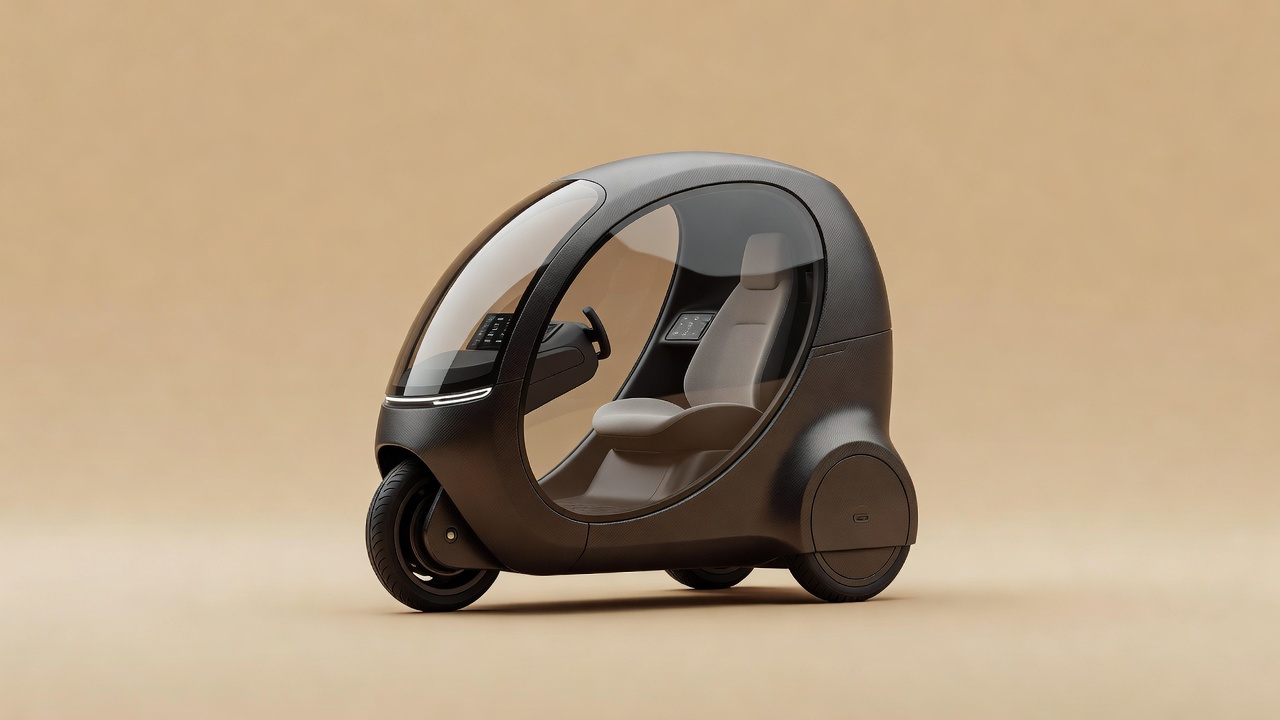
The mission comes before the machine
“Personal transportation” covers incompatible tasks. A short trip over level streets is not a winter commute on rural roads, and neither resembles a flight between prepared landing sites. Before judging a concept, state the trip distance, surface, weather, payload, storage needs and available infrastructure. Without a mission, a design can appear superior simply by avoiding the hardest part of the comparison.
The baseline matters too. A bicycle, an electric bicycle, a small car and public transport solve different combinations of speed, shelter and access. An experimental machine should be compared with the option a person could realistically use for that journey. A dramatic maximum speed says little about a trip dominated by crossings, boarding time or the search for parking.
The enclosed cycle: a modest-looking frontier
Velomobiles combine human-scale propulsion with aerodynamic bodywork, often using three wheels and a recumbent seating position. Their appeal is not mysterious: shelter and reduced drag can extend the usefulness of a cycle. Their compromises include access, visibility, ventilation, turning space and the difficulty of moving a larger object through infrastructure designed around conventional bicycles.
Electric assistance can make hills and repeated starts easier, but changes the mass, maintenance and regulatory picture. Classification depends on the actual vehicle and jurisdiction, not on whether the designer calls it a bicycle. Weather protection also needs careful interpretation: a shell that deflects rain may not provide crash protection comparable with a passenger car.
Trade-off / Shelter versus simplicity
An open cycle exposes its rider but remains easy to inspect, lift and store. An enclosure can improve comfort and airflow around the vehicle while adding crosswind sensitivity, panels, hinges and ventilation requirements. The better option follows the trip rather than a universal hierarchy of futuristic design.
Balancing is a continuous responsibility
Self-balancing vehicles exchange passive geometry for active sensing and control. The Segway Personal Transporter made this trade widely recognizable. An inertial measurement system, control electronics and motors cooperate to maintain a usable attitude. The rider experiences an intuitive interface, while the machine continuously manages an unstable or partly unstable configuration.
That arrangement brings questions about low battery conditions, traction limits, obstacles and component faults. More software does not automatically produce safer behavior, just as fewer moving parts do not guarantee reliability. The important evidence is how the complete system behaves when sensors disagree or the demanded corrective force exceeds what the tires and motors can provide.
The air above the traffic is not empty
Electric vertical takeoff and landing concepts promise access without a runway, but the aircraft still needs a suitable place to depart and arrive. Noise, rotor clearance, downwash, charging, weather limitations and emergency procedures become part of the service. A vehicle that avoids a road can create new demands on the surrounding ground.
Programs such as Joby Aviation and Wisk illustrate substantial development activity, not a blanket answer for private commuting. Certification status and operating permissions change over time and must be checked directly. The FAA and the European Union Aviation Safety Agency provide regulatory context; a promotional flight video is not a substitute for their applicable requirements.
The last difficult kilometer is often not a propulsion problem. It is a place, a rule or another person.
Demonstrated, developed, dependable
A bench demonstration establishes a mechanism under stated conditions. An integrated prototype shows that several subsystems can work together. A repeatable field trial adds environmental exposure and operational learning. A dependable transport service needs much more: production quality, maintenance, training, infrastructure, incident response and a sustainable operating model.
Those stages are not insults to early research. They are useful labels that prevent evidence from being stretched. NASA’s Ingenuity, for example, demonstrated remarkable rotorcraft operation in the thin Martian atmosphere. Its scientific and engineering value does not make its layout a ready terrestrial passenger vehicle. Context is part of the achievement, not a footnote to remove.
A small ledger for a large claim
Record the vehicle’s total operating mass, payload, energy source, demonstrated duration and test environment. Note whether the run was tethered, remotely supervised or autonomous. Look for repeated trials and an explanation of failures. If the published evidence does not resolve a question, label it unknown rather than filling the gap with enthusiasm.
Start with project information from Joby Aviation and Wisk, then compare the framing with the FAA and EASA. For the everyday engineering underneath the spectacle, revisit load paths and mass or bring a documented claim to the workbench.